
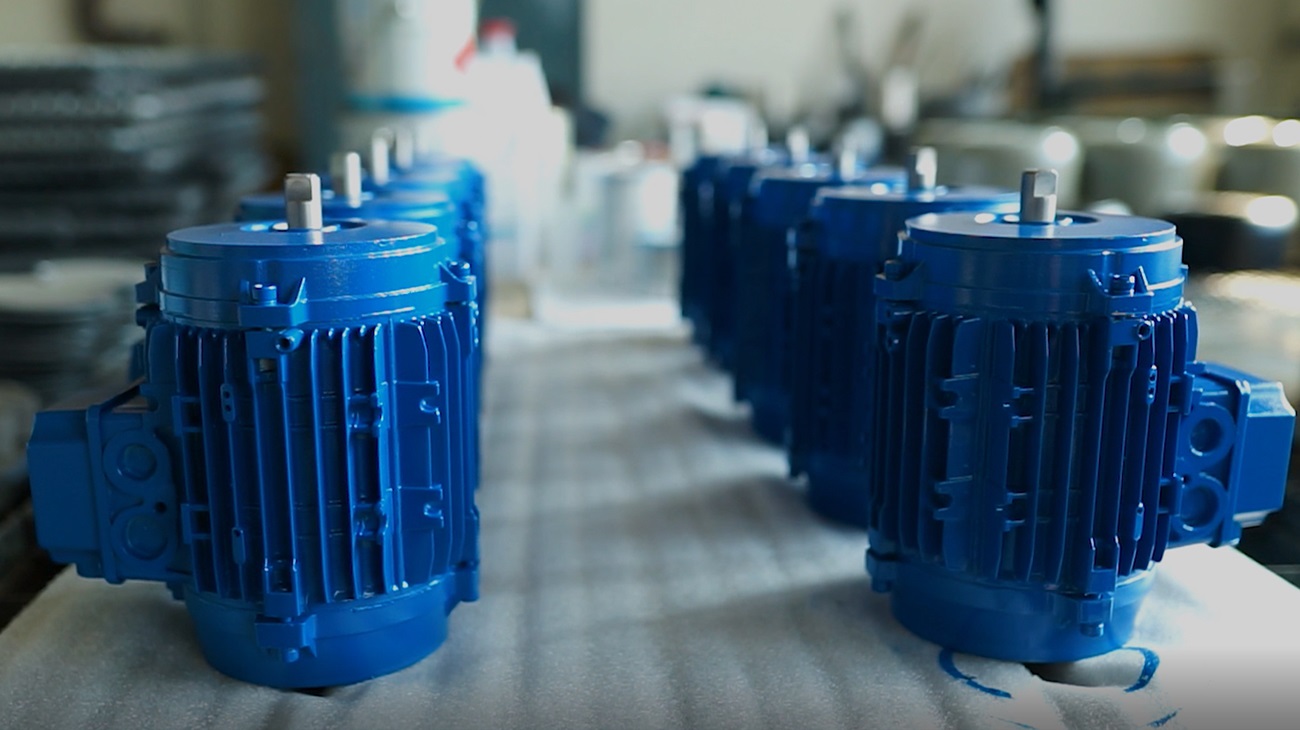
A well-chosen electric motor runs reliably and economically, without unnecessary compromises. When choosing one, it pays to go through five basic parameters – you can use the same parameters to search for a motor in our motor catalogue.
1. Number of phases and voltage
Single-phase motors (1x230V) suit places without a three-phase supply – for example smaller machines and equipment. Three-phase motors (3x400V) are the industrial standard: they offer higher efficiency, smoother running and easier starting.
2. Rated power
Choose the power according to the actual load of the driven equipment. An oversized motor runs with lower efficiency and a poorer power factor; an undersized one overheats and its service life is shortened. Our catalogue includes motors from 0.06 to 4 kW.
3. Number of poles and speed
The number of poles determines the motor speed. At 50 Hz, approximately:
| Number of poles | Synchronous speed | Rated speed (approx.) |
|---|---|---|
| 2 | 3000 rpm | ≈ 2800 rpm |
| 4 | 1500 rpm | ≈ 1400 rpm |
| 6 | 1000 rpm | ≈ 900 rpm |
| 8 | 750 rpm | ≈ 650 rpm |
You will find the exact rated speed of each motor in its technical parameters.
4. Mounting arrangement
The mounting arrangement determines how the motor is fixed to the equipment – on feet, by a flange, or a combination of both.
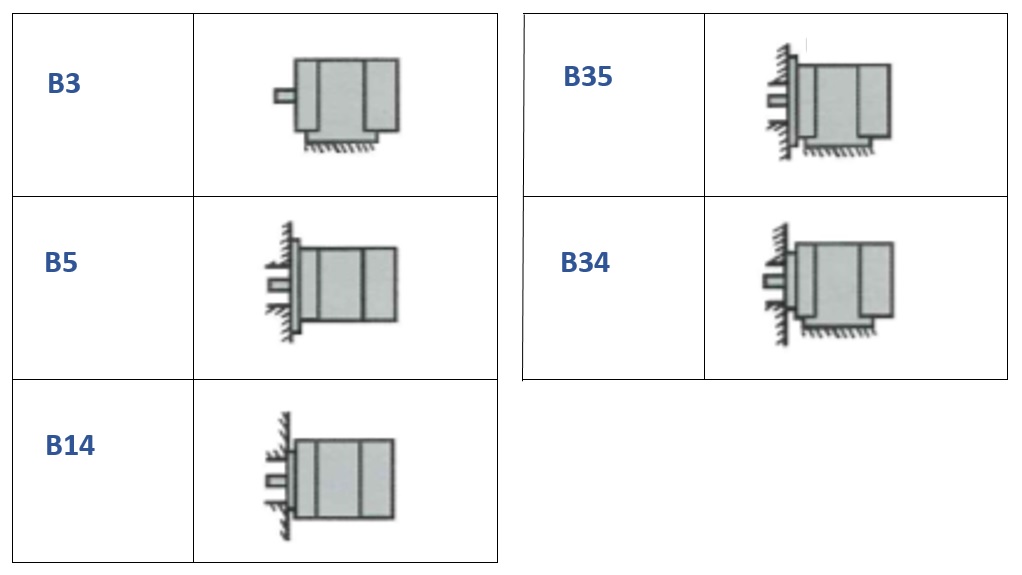
- B3 – foot-mounted motor
- B5 – flange-mounted motor (flange with through holes)
- B14 – flange-mounted motor with a smaller flange with threaded holes
- B35 – feet combined with a B5 flange
- B34 – feet combined with a B14 flange
We supply EMP motors in all of these arrangements, with B14 and B34 in variants a/b.
5. Efficiency class
Efficiency classes IE1 to IE3 are based on the international standard IEC 60034-30-1. A motor in a higher class uses less energy for the same output, which quickly shows in the costs of continuous operation. In addition, European ecodesign rules require a minimum efficiency class for many applications – we will be happy to advise which class suits your use.
Not sure what to choose?
Choose a motor in our motor catalogue by number of phases, power, poles and starting, or contact us. If none of our standard motors suits you, we will design and build a motor exactly to your requirements.